Merchant Services 101
What “BANKCARD MTOT DEP” and “MTOT DISC” Mean on Your Bank Statement
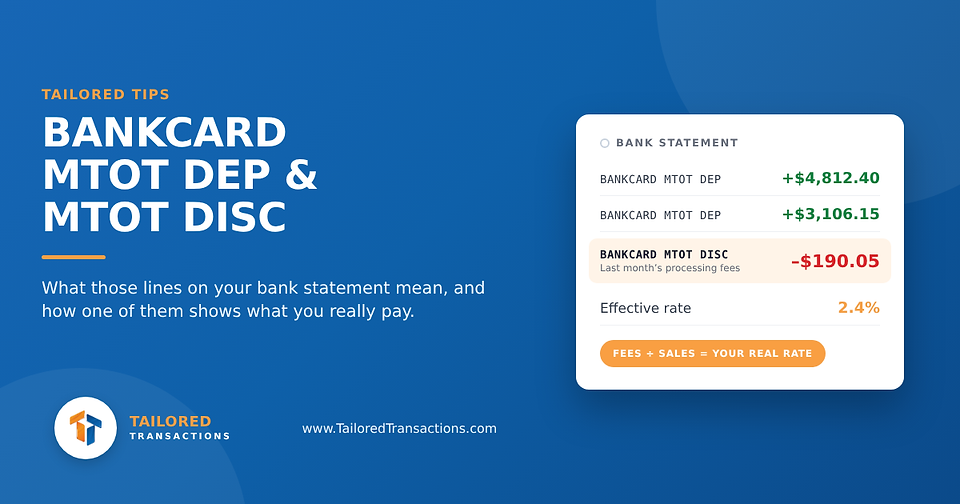
If you accept cards, your bank statement is full of lines that look like a code: BANKCARD MTOT DEP, BANKCARD BTOT DEP, MTOT DISC, BTOT ADJ. They are not a mystery charge and they are not a scam. They are your card processing, deposits coming in and fees going out, labeled the way your processor’s settlement bank labels them. Here is how to read every one of them, and how to use one of them to find out what you really pay.
Decoding the abbreviations
The labels are built from a few pieces:
BANKCARD means the entry comes from card processing (your merchant account), as opposed to a check, a transfer or a bill payment.
BTOT is the batch total: the net amount of one day’s settled sales.
MTOT is the merchant total. Depending on the processor it labels the daily deposit, the monthly fee debit, or both.
DEP is a deposit. Money in.
DISC is short for “discount,” the industry’s old word for processing fees. Money out.
ADJ is an adjustment: a chargeback, a reversal or a correction to an earlier deposit.
FEE or INTERCHNG sometimes appear as separate debits for monthly fees or interchange pass-through.
So “BANKCARD MTOT DEP” is a card-sales deposit, “BANKCARD MTOT DISC” is your processing fees being taken out, and “BANKCARD BTOT ADJ” is a chargeback or correction.
These particular labels are typical of processors that settle through the Fiserv (First Data) platform. Other platforms use their own wording, such as MERCH DEP, MERCHANT BANKCD DEPOSIT or the processor’s name, but the structure is the same: a deposit line, a fee line, an adjustment line. One thing the label does not tell you is who your processor is. “Bankcard” is a generic word here, not the name of the company holding your account. Tailored Transactions accounts use these labels too: your deposits post as BANKCARD MTOT DEP, and your monthly fees as the matching DISC line.
The deposit lines: BANKCARD MTOT DEP and BTOT DEP
Each deposit is the net of one settled batch: that day’s card sales minus any refunds you issued, and minus chargebacks if your processor nets them daily. It arrives one to two business days after you close the batch. Next day funding, which every Tailored Transactions account has, means the batch you close tonight is in your account tomorrow.
If you take cards on three terminals and close three batches, you may see three deposits, or one combined deposit, depending on how the account was set up.
The deposit is rarely the exact total of your sales, and that is normal. What you want to confirm is that it equals the batch report from your terminal or gateway, minus refunds. If it does not, the ADJ line usually explains why.
The fee line: MTOT DISC
MTOT DISC is your processing fee, and it is the line to watch. It covers everything you paid to accept cards for the period: interchange (paid to the banks that issued your customers’ cards), assessments (paid to Visa, Mastercard, Discover and AMEX), and your processor’s markup, plus any monthly, PCI, statement or batch fees your processor charges.
When it posts depends on how your account is set up:
Monthly discount. Your deposits arrive in full every day, and one MTOT DISC debit for the previous month’s fees hits in the first few business days of the next month. This is the common setup, and it is the one that makes people search for this term, because the debit is large and arrives all at once.
Daily discount. Fees are taken out of each day’s deposit before it lands. The deposits are smaller and there is no big monthly debit, which makes the cost of processing much harder to see.
Neither is cheaper than the other. Monthly discount is simply easier to audit, and we set accounts up that way unless a client prefers otherwise.
How to tell if that MTOT DISC debit is too high
This is the useful part. Take last month’s MTOT DISC amount and divide it by last month’s total card sales. That is your effective rate, the single most honest number in payment processing.
A business with $50,000 in monthly card sales and a $1,600 MTOT DISC debit is paying an effective rate of 3.2%. On the same card mix, a true Cost-Plus account prices every transaction at the card brands’ wholesale interchange plus a fixed markup that never exceeds 0.30%, with no PCI, statement, batch or annual fees stacked on top. The difference between those two numbers, every month, is what you are overpaying.
If your effective rate is above 3%, something on that account is wrong: a bundled or tiered rate, junk fees, a wrong merchant category code, or missing Level 2/3 data on business cards. All four show up on the processing statement behind the debit.
What to do if you don’t recognize the charge
If you own a business that accepts cards, you do. It is your processing. The processor’s name is on the monthly statement they mail or email you, and the debit should match that statement’s total fees to the penny. If it does not, call the processor.
If you do not run a business, or you closed your merchant account and the debits continue, call your bank the same day. The common explanations are a merchant account that was never properly closed, an account linked to the wrong bank account by mistake, or, rarely, a merchant account opened in your name without your knowledge.
A simple monthly reconciliation
Five minutes a month keeps processing honest:
Match every BANKCARD DEP to a batch report. The amounts should agree after refunds.
Check every ADJ line. Each one should correspond to a chargeback or correction you know about.
Compare the MTOT DISC debit to the total fees on your processing statement.
Divide fees by sales for your effective rate, and write it down. Watch it month to month. A rising rate with the same sales mix usually means a rate increase you were never told about.
If you would rather we do step four for you, send us the statement behind that MTOT DISC line. We will show you where every dollar went and what the same month would have cost on Cost-Plus pricing, in writing, within one business day. If your current processor is already giving you a fair deal, we will say so.
READY TO OPTIMIZE?
Get Your Free Savings Analysis
Send us the processing statement behind that MTOT DISC debit and we’ll show you exactly where the money went and what Cost-Plus pricing would save.
No obligation. No contracts. No ETF.